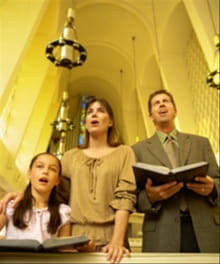
Give unto the Lord the glory due to His name (Psalm 29:2).
It's Sunday around noonish. As the congregation files out of the sanctuary heading toward the parking lot, listen closely and you will hear it.
It's a common refrain voiced near the exit doors of churches all across this land.
"I didn't get anything out of that today." "I didn't get anything out of the sermon." "I didn't get anything out of that service." "I guess her song was all right, but I didn't get anything out of it."
Sound familiar? Not only have I heard it countless times over these near-fifty years in the ministry, I probably have said it a few times myself.
This is like dry rot in a congregation. Like a termite infestation in the building. Like an epidemic afflicting the people of the Lord, one which we seem helpless to stop.
But let's try. Let's see if we can make a little difference where you and I live, in the churches where we serve and worship. We might not be able to help all of them, but if we bless one or two, it will have been time well spent.
1. You are Not Supposed to 'Get Anything Out of the Service'
Worship is not about you and me. Not about "getting our needs met." Not about a performance from the pastor and singer and choir and musicians. Not in the least.
2. Worship is About the Lord
"Give unto the Lord the glory due to His name." That Psalms 29:2 verse atop our article today is found also in 1 Chronicles 16:29 and Psalms 96:8. It deserves being looked at closely.
a) We are in church to give. Not to get.
Now, if I am going somewhere to "get," but find out on arriving, I am expected to "give," I am one frustrated fellow. And that is what is happening in the typical church service. People walk out the door frustrated because they didn't "get." The reason they didn't is that they were not there to "get," but to "give."
Someone should have told them.
b) We are giving glory to God. Not to man.
We know that. At least we say we do. How many times have we recited, "...for thine is the kingdom and the power and the glory"? And how often have we sung, "Praise God from whom all blessings flow..."?
c) We do so because glory is His right. He is "worthy of worship."
This is the theme of the final book of the Bible.
- "Who is worthy?" (Rev. 5:2)
- "You are worthy...for you were slain, and have redeemed us" (Rev. 5:9).
- "Worthy is the Lamb that was slain" (Rev. 5:12).
3. Self-centeredness Destroys All Worship
If my focus is on myself when I enter the church--getting my needs met, learning something, hearing a lesson that blesses me, being lifted by the singing--then Christ has no part in it. He becomes my servant, and the pastor (and all the other so-called performers) are there only for me. It's all about me.
We have strayed so far from the biblical concept of worship--giving God His due in all the ways He has commanded--it's a wonder we keep going to church. And it's an even greater wonder that our leaders keep trying to get us to worship.
The poor preacher! Trying to cater to the insatiable hungers of his people, even the best and most godly among them, is an impossible task. One week he gets it right and eats up the accolades. Then, about the time he thinks he has it figured out, the congregation walks out grumbling that they got nothing out of the meal he served today.
The typical congregation in the average church today really does think the service is all about them--getting people saved, learning the Word, receiving inspiration to last another week, having their sins forgiven, taking an offering to provision the Lord's work throughout the world.
Anything wrong with those things? Absolutely not. But if we go to church to do those things, we can do them. But we will not have worshiped.
Warren Wiersbe says, "If you worship because it pays, it will not pay."
4. Evangelism & Discipleship, Giving & Praying, Grow Out of Worship; Not the Other Way Around
The disciples were worshiping on the Day of Pentecost when the Holy Spirit filled them and drove them into the streets to bear a witness to the living Christ (Acts 2).
Isaiah was in the Temple worshiping when God appeared to him, forgave his sins, and called him as a prophet to the people (Isaiah 6).
It was in the act of worship that the two distraught disciples had their eyes opened to recognize Jesus at their table (Luke 24).
5. We are to Give Him Worship and Glory in the Ways Scripture Commands
"Give to the Lord the glory due His name and bring an offering." So commands I Chronicles 16:29 and Psalm 96:8.
"The sacrifices of God are a broken spirit. A broken and contrite heart--these, O God, you will not despise." (Psalm 51:17)
Singing, praise, rejoicing. Praying, offering, humbling, loving. All these are commanded in worship at various places in Scripture.
The Lord Jesus told the Samaritan woman at Jacob's well, "Those who worship God must worship in spirit and in truth" (John 4:24). That is, with their inner being, the totality of themselves, their spirit, not just their lips or their bodies going through the motions. And in truth--the revealed truth of how God has prescribed worship to take place. He is not pleased with "just anything" that we claim as worship.
We must balance our worship between spirit (the subjective part: body, soul, emotions) and truth (the objective aspect: all that God has revealed in His word).
6. We Are the Ones Who Decide Whether We Worship upon Entering the House of the Lord
Don't blame the preacher if you don't worship. He can't do it for you.
No one else can eat my food for me, love my cherished ones in my place, or do my worshiping for me.
No pastor can decide or dictate whether we will worship by the quality of his leadership or the power of his sermon. Whether I worship in today's service has absolutely nothing to do with how well he does his job.
I am in charge of this decision. I decide whether I will worship.
When Mary sat before the Lord Jesus, clearly worshiping, He informed a disgruntled Martha that her sister had "chosen the good part," something that "will not be taken away from her" (Luke 10:42). That something special was time spent in worship. Such moments or hours are eternal.
Lest someone point out that Martha could have worshiped in her kitchen by her service for Christ, we do not argue, but simply point out that she was not doing so that day.
7. Remember: Worship is a Verb
And it's an active verb at that.
Worship is something we do, not something done to us.
In the worst of circumstances, I can still worship my God. In the Philippians prison, while their backs were still oozing blood from the beating they'd received, Paul and Silas worshiped (Acts 16:25).
Even if a church has no pastor and has to make do with a stuttering layman or some inept fill-in, I can still bow before the Lord, offer Him my praise, and give Him my all. I can humble before Him and I can bring my offering.
What I cannot do is leave church blaming my failure to worship on the poor singing, the boring sermon, or the noise from the children in the next pew. I am in charge of the decision whether I will worship, and no one else.
Someone has pointed out that ours is the only nation on earth where church members feel they have to have "worshipful architecture" before they can adequately honor the Lord. Millions of Christians across the world seem to worship just fine without any kind of building. Believers in Malawi meet under mango trees, according to retired missionary Mike Canady, and their worship is as anointed as anyone's anywhere. (What? No stained glass!)
Our insistence on worshipful music, worship settings, and worshipful everything are all signs of our disgusting self-centeredness.
It's disgusting because I see it in myself, and do not like it.
No one enjoys a great choir more than I. I love to hear a soloist transport us all into the Throneroom by his/her vocal offering in the service. A great testimony of God's grace and power thrills me. And of course, being a preacher, I delight in hearing a sermon that you feel is direct from the heart of God.
But if I require any one or all of those before I can worship, something is vastly wrong with me.
My friends, something is vastly wrong with us today.
Dr. Joe McKeever is a Preacher, Cartoonist, and the Director of Missions for the Baptist Association of Greater New Orleans. Visit him at joemckeever.com/mt. Used with permission.

 1. Don’t participate, merely consume.